

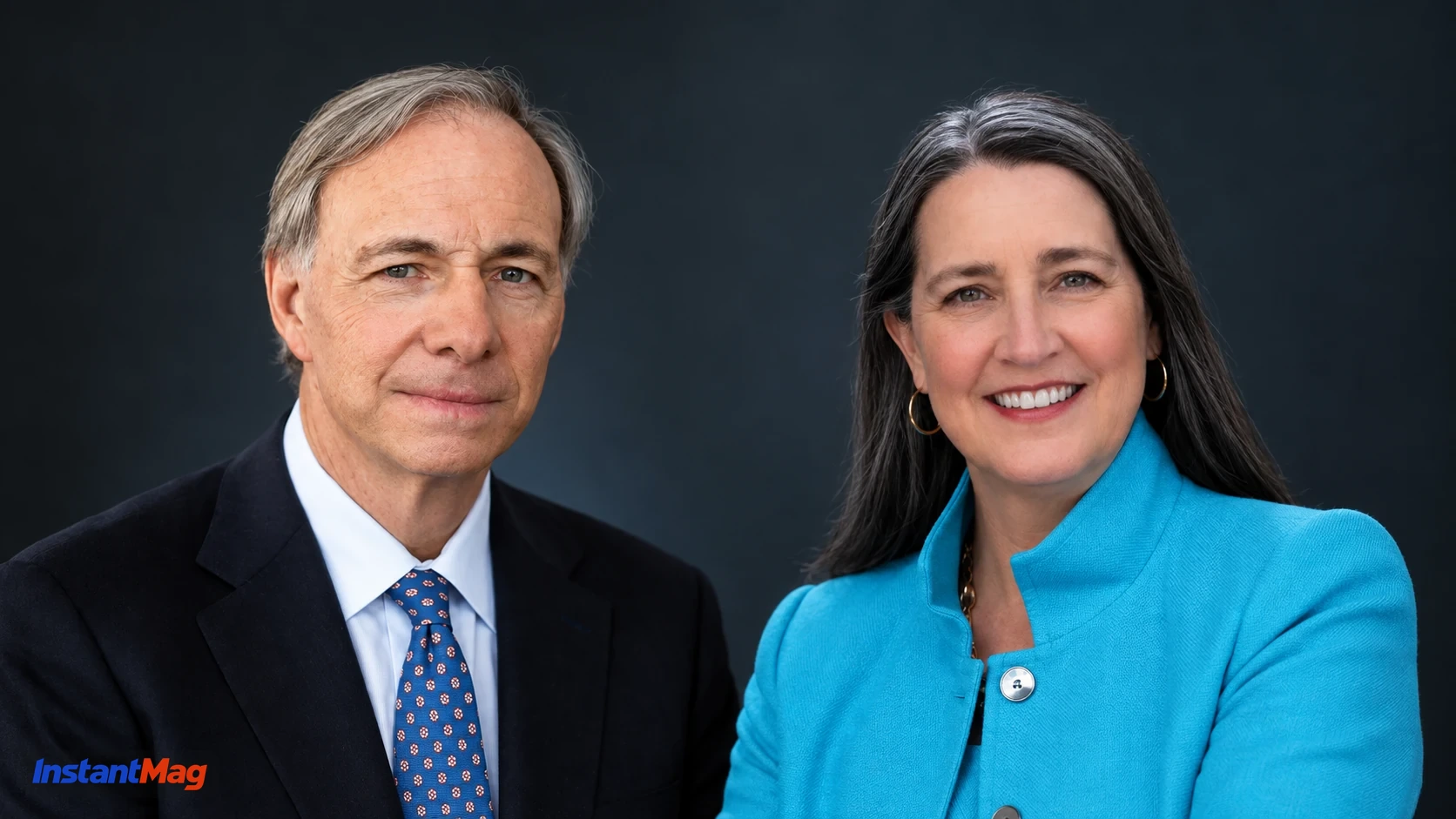
Ray Dalio and Patricia Poppe are not publicly confirmed as business partners, relatives, or direct professional collaborators. The strongest documented link between their names is more specific: Bridgewater Associates, the investment firm Dalio founded, reported a large stake in PG&E Corporation in 2026 while Poppe was serving as PG&E Corporation’s chief executive.
That distinction matters. In its Form 13F for the quarter ended June 30, 2026, Bridgewater Associates reported 5,931,314 PG&E Corporation shares valued at $99,764,701. Three months earlier, it had reported 24,531 shares valued at $431,010. Those are Bridgewater holdings reported in regulatory filings, not proof that Dalio personally bought the shares, chose the position or owned the economic interest behind it.
The two figures therefore have separate public careers with one notable institutional overlap. Dalio built Bridgewater into a major investment-management firm before stepping away from its executive leadership, control and ownership. Poppe moved from engineering and manufacturing into the utility industry and now leads PG&E Corporation, one of the most closely scrutinised energy companies in the United States.
What Actually Connects Ray Dalio and Patti Poppe?
The clearest connection is Bridgewater’s disclosed investment in PG&E Corporation.
Bridgewater Associates, LP reported 5.93 million PG&E shares at June 30, 2026, according to its SEC Form 13F information table. Its previous quarter-end filing showed 24,531 shares. That means the reported position increased by 5,906,783 shares between the two quarter-end snapshots.
A Form 13F does not reveal everything about an investment. It shows certain reportable securities over which an institutional investment manager exercises investment discretion. It does not necessarily identify the ultimate client who owns the economic exposure, the individual portfolio manager who made a decision, the exact dates of trades or the investment thesis behind them.
That is why describing the filing as “Ray Dalio’s $99.8 million PG&E investment” would be misleading. By 2026, Dalio was no longer Bridgewater’s CEO, chief investment officer or chairman. Bridgewater said its transfer of control to a new generation of leadership was completed in 2022, and Reuters reported in July 2025 that the firm had repurchased the final ownership shares held by Dalio-related entities.
There is also no public confirmation that Dalio and Poppe have a direct personal, family or professional relationship. The institutional connection is real; a personal one is not established.
Ray Dalio: From Investor to Bridgewater Founder
Dalio founded Bridgewater Associates in 1975. According to Bridgewater’s current biography, he started the firm from his New York apartment after earlier work in financial markets.
His academic background was in finance. He received a bachelor’s degree in finance from C.W. Post College in 1971 and an MBA from Harvard Business School in 1973.
Bridgewater initially worked with companies and institutional clients on economic and financial risks. It later became best known for global macro investing, an approach that studies broad forces such as inflation, growth, interest rates, currencies and monetary policy rather than concentrating only on individual companies.
The firm’s own historical material gives slightly different dates for the beginning of its World Bank asset-management relationship, placing it in the mid-1980s. Because Bridgewater’s published histories are not consistent on the precise year, the broader chronology is safer than treating either date as definitive.
All Weather and Dalio’s investment ideas
One of the strategies most closely associated with Dalio is All Weather. Bridgewater says the approach was developed in 1996, initially for Dalio’s trust assets.
The central idea was to build a portfolio that was less dependent on one particular economic environment. Bridgewater’s account describes the strategy as an attempt to balance risk across different conditions, especially unexpected changes in economic growth and inflation.
Dalio also became known far beyond the investment industry for his ideas about organisational decision-making. Bridgewater has described the culture he promoted in terms such as an “idea meritocracy,” with an emphasis on challenging assumptions, discussing errors and making disagreements visible.
Those ideas reached a larger audience through Principles: Life and Work, published in September 2017. Dalio later published Principles for Dealing with the Changing World Order in November 2021 and How Countries Go Broke in June 2025.
The books extended his public role from investor to commentator on economic cycles, debt, institutions and decision-making. His recent work has continued to focus heavily on government debt and the historical patterns he believes shape financial and political systems.
Leaving Bridgewater’s leadership and ownership
Dalio’s name remains inseparable from Bridgewater’s history, but his current relationship with the firm is different from the one he had while running it.
Bridgewater says he stepped down as CEO in 2017, left the chief investment officer role in summer 2020 and stepped down as chairman at the end of 2021. The firm announced in October 2022 that its transition of control to the next generation had been completed.
Reuters then reported on July 31, 2025, that Bridgewater had repurchased the last ownership shares held by Dalio-related entities. Bridgewater’s current founder page describes his role principally in terms of mentoring people at the firm and beyond.
That chronology is central to understanding the Dalio–Poppe query. A 2026 Bridgewater securities filing should not be treated as though Dalio still personally controlled the company’s investment decisions.
Patricia “Patti” Poppe: From Engineering to Energy Leadership
Patricia K. Poppe, commonly known as Patti Poppe, built her career through engineering, manufacturing and utility operations rather than financial markets.
She earned bachelor’s and master’s degrees in industrial engineering from Purdue University and later completed a master’s degree in management at Stanford Graduate School of Business.
Her early career included roughly 15 years at General Motors, where she worked in manufacturing and operational roles. She moved to DTE Energy in 2005 and later joined Consumers Energy in 2011.
In a 2024 discussion at UC Berkeley’s Haas School of Business, Poppe described the move from General Motors to DTE partly in the context of her family deciding to establish roots in Michigan after frequent relocations. It was a practical personal decision that also changed the direction of her professional career.
At Consumers Energy and its parent CMS Energy, Poppe took on increasingly senior positions across operations, engineering, customer service, regulation and utility management. She became president and CEO of CMS Energy and Consumers Energy effective July 1, 2016.
Taking Over PG&E After Bankruptcy
PG&E Corporation announced Poppe’s appointment in November 2020, and she became CEO on January 4, 2021.
She entered the job at an unusually difficult point in PG&E’s history. The company had emerged from bankruptcy on July 1, 2020, only about six months before her arrival. The bankruptcy followed years of wildfire liabilities, regulatory pressure and scrutiny of the utility’s safety practices.
The California Public Utilities Commission placed Pacific Gas and Electric Company into an enhanced oversight and enforcement process in April 2021 because of shortcomings in the way it had prioritised high-risk vegetation-management work during 2020.
The timing is important. Those 2020 shortcomings predated Poppe’s tenure as CEO, although the regulatory consequences became part of the operating environment she inherited.
Her job therefore involved more than ordinary utility management. PG&E faced the simultaneous demands of wildfire mitigation, infrastructure investment, reliability, customer affordability, regulatory compliance and access to financing.
Wildfire Mitigation and Underground Power Lines
One of the most visible PG&E programmes during Poppe’s tenure has been the undergrounding of electrical distribution lines in high-fire-risk areas.
PG&E said in October 2025 that it had energised 1,000 miles of underground power lines across high-fire-risk areas in 27 California counties. The company said Poppe had announced the undergrounding programme in 2021.
The 1,000-mile figure is a concrete infrastructure milestone reported by PG&E. Broader claims about exactly how much the programme reduces wildfire risk or whether undergrounding is the most cost-effective approach require more context and should not be treated simply as settled facts because the company states them.
The programme nevertheless illustrates the scale of the operating challenge Poppe has faced. Unlike an investment portfolio, an electric grid cannot be adjusted with a trade. Large utility decisions involve physical construction, regulatory approval, financing, customer rates and infrastructure that may remain in service for decades.
PG&E’s 2026 Strategic Review
Poppe’s current work is also shaped by affordability and financing pressures.
On September 2, 2026, PG&E announced a strategic review of its plans and said it would defer about $2 billion of work that had previously been scheduled for 2027. At the same time, the company said it still expected to invest roughly $11.4 billion in California during 2027.
The review was presented as an effort to balance investment needs with customer affordability and financing constraints. It remains an ongoing process, so its eventual outcome should not be treated as a completed restructuring.
This is the most current major development in Poppe’s tenure as of September 27, 2026. It places her at the centre of a familiar utility problem: how to maintain and strengthen critical infrastructure while limiting the financial burden on customers.
PG&E Corporation and Pacific Gas and Electric Company Are Different
The distinction between PG&E Corporation and Pacific Gas and Electric Company is easy to miss, but it matters when describing Poppe’s current role.
Poppe remains CEO of PG&E Corporation, the parent company. She is also a director of both PG&E Corporation and its regulated utility subsidiary.
Since January 1, 2026, however, Sumeet Singh has been CEO of Pacific Gas and Electric Company, the utility subsidiary. Current descriptions that call Poppe the utility’s CEO are therefore out of date.
That corporate distinction also helps clarify the Bridgewater investment. The 2026 Form 13F position was in PG&E Corporation shares, the publicly traded parent company led by Poppe.
Two Careers That Meet Only Indirectly
Dalio and Poppe have worked in very different environments.
Dalio’s public career developed around investment markets, economic research, portfolio construction and the management culture he built at Bridgewater. His major work now centres on books, public commentary and mentoring after a long transition away from Bridgewater’s executive leadership and ownership.
Poppe’s career developed through industrial engineering, manufacturing, power generation and regulated utility management. At PG&E Corporation, her decisions are tied to physical infrastructure, wildfire risk, regulatory scrutiny, financing and customer bills.
The Bridgewater–PG&E shareholding creates a genuine institutional link between their names, but it does not make Dalio and Poppe partners. There is no public confirmation that Dalio personally selected the PG&E position, advised Poppe, worked with her or held the shares for his own account.
Are Ray Dalio and Patricia Poppe Related?
There is no public confirmation that Ray Dalio and Patricia “Patti” Poppe are related.
Their documented careers are separate: Dalio is the founder of Bridgewater Associates, while Poppe is the CEO of PG&E Corporation. The connection that can be stated confidently is that Bridgewater reported a substantial PG&E Corporation position in 2026.
Did Ray Dalio Personally Invest in PG&E?
The public filing does not establish that.
Bridgewater Associates reported the PG&E shares on its institutional Form 13F. SEC rules make clear that such filings concern securities over which an institutional investment manager exercises investment discretion. They do not automatically identify the personal holdings of a founder or former executive.
By the time of the 2026 PG&E filing, Dalio had already left Bridgewater’s main executive roles, the firm had completed its control transition, and Reuters had reported the repurchase of his remaining ownership stake.
What Are Ray Dalio and Patti Poppe Doing Now?
As of September 27, 2026, Bridgewater describes Dalio as its founder and as a mentor rather than a current executive. His recent public work has focused on debt, economic cycles and the themes developed in his 2025 book How Countries Go Broke.
Poppe remains CEO of PG&E Corporation. Her current agenda includes the company’s strategic review, long-term infrastructure investment, wildfire-risk work and efforts to address the cost of financing California’s energy system.
The connection between Ray Dalio and Patricia Poppe is therefore narrower than some search results suggest, but more concrete than a purely invented leadership comparison. Bridgewater, the firm Dalio created decades ago but no longer controls or owns, reported a major investment in the company Poppe currently leads. Everything beyond that requires evidence the public record does not presently provide.
