


Carlos Tarajano was a New York-based finance professional who worked as a fixed-income trader at Deutsche Bank Securities. He is best known as the first husband of American actress Kelly Rutherford, whom he married in June 2001. Rutherford filed for divorce in January 2002, following a serious medical emergency during their marriage. Tarajano died in New York on 2 November 2004.
His family’s death notice, published in the Miami Herald in November 2004, identifies him as Carlos Tarajano y R. Arellano. It confirms his education, profession and death. Later reporting, including a 2015 Vanity Fair interview with Rutherford, provides further details about their brief marriage.
A career in fixed-income trading
Carlos Tarajano worked in finance before his marriage brought him into entertainment coverage.
According to his family’s November 2004 death notice, he graduated from Boston University in 1992 with a degree in business administration.
He subsequently worked at Deutsche Bank Securities, where his documented role was fixed-income trader.
Fixed-income trading involves buying and selling financial instruments such as government bonds, corporate bonds and other debt securities. Their prices respond to factors including interest rates, credit risk and economic conditions.
Traders working in this field may help financial institutions and clients manage investments, execute transactions and respond to changing market prices.
Tarajano’s specific trading responsibilities, professional transactions and compensation haven’t been publicly detailed. His family’s notice nevertheless establishes a more precise occupation than the broad description of him as a businessman.
An autobiographical account published under his name also describes him as a bond trader and bank vice-president around 2001. The account survives on a third-party website, although its original authorship and publication date haven’t been independently authenticated.
The distinction matters because later biographies sometimes describe a lengthy entrepreneurial career without identifying projects or businesses that can be reliably connected to him.
His documented professional background was in banking and fixed-income markets.
An international background before New York
Tarajano was described as a Venezuelan banker in contemporary entertainment coverage, including reporting about his marriage to Rutherford.
An undated biographical account published under his name offers a more detailed description of his background.
The first-person text describes Cuban family heritage, a birthplace in Puerto Rico and an upbringing across Spain, Mexico and Venezuela.
It also states that he attended college in Boston and had lived in New York for approximately 11 years.
Those details are consistent with a life involving several countries, although the text doesn’t establish his legal citizenship or provide a separately authenticated birth record.
His Boston University graduation is independently documented by the family death notice.
By the time he entered entertainment reporting in 2001, Tarajano was working in New York’s financial sector.
His relationship with Rutherford subsequently introduced his name to a different audience.
Marriage to Kelly Rutherford in June 2001
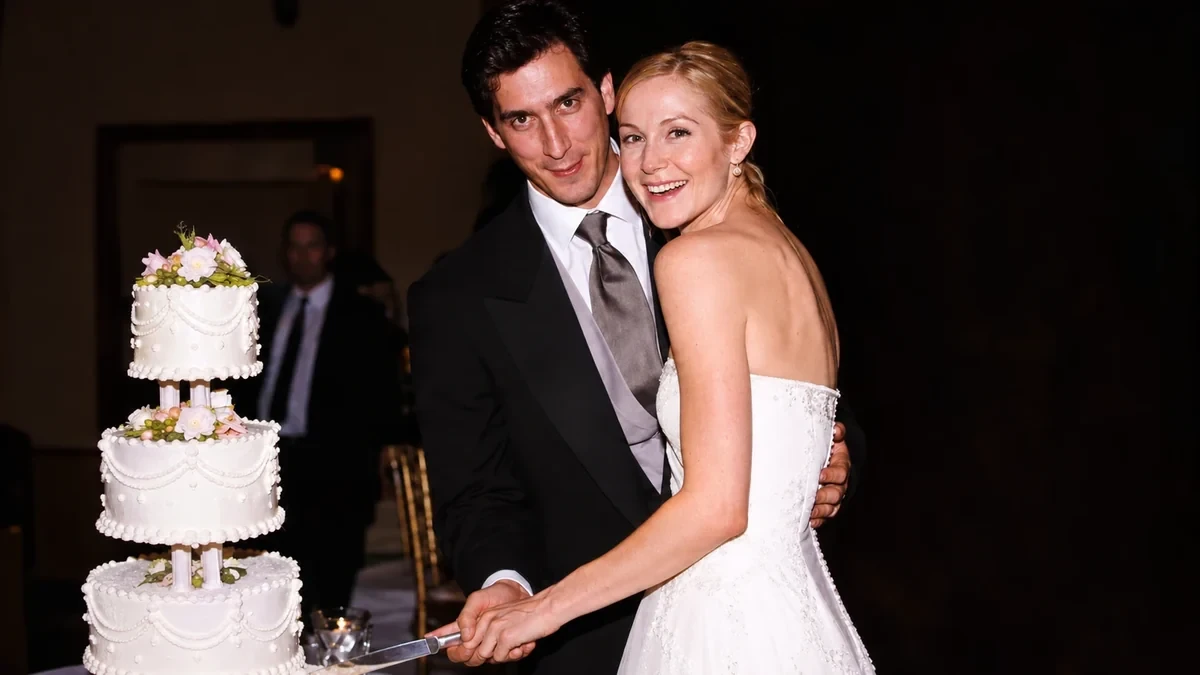
Carlos Tarajano married Kelly Rutherford in June 2001, when she was already an established television actress.
Rutherford had appeared in Generations and played Megan Lewis in Melrose Place during the 1990s. She would later become widely recognised for portraying Lily van der Woodsen in Gossip Girl, which began airing in 2007.
The couple’s wedding attracted entertainment-media coverage.
Historical reporting published by InStyle and The New York Times, preserved in third-party reproductions, places the ceremony on 30 June 2001 at the Good Shepherd Catholic Church in Beverly Hills.
The accounts also describe a reception at the Beverly Hills Hotel, attended by approximately 140 guests.
A reproduced February 2002 InStyle feature provides details about the relationship before the wedding. It describes the couple meeting at a New York restaurant and Tarajano sketching an engagement-ring design.
These details come from reproductions of contemporary magazine reporting rather than authenticated copies of the original print editions.
Still, they provide a clearer picture of how the relationship was presented publicly at the time.
Wedding publicity continued after the separation
One unusual feature of the marriage was the timing of its media coverage.
Rutherford filed for divorce in January 2002, but material prepared around the wedding continued appearing afterwards.
A historical Entertainment Tonight account gives 11 January 2002 as the filing date.
According to a reproduced article by Alex Kuczynski, published in The New York Times on 2 June 2002, wedding footage appeared in NBC’s InStyle Celebrity Weddings programme on 22 January.
The February 2002 issue of InStyle also featured the wedding.
As a result, television audiences and magazine readers encountered coverage of the couple’s wedding after Rutherford had already initiated divorce proceedings.
The difference between the wedding date and the publication dates explains an otherwise confusing aspect of their public timeline.
It doesn’t establish that the publicity contributed to the separation.
A serious medical emergency in October 2001
Tarajano experienced a major health crisis a few months after his wedding.
The biographical account hosted by Wizart states that he suffered cardiac arrest on 1 October 2001.
In that account, he describes waking in hospital approximately six weeks later and learning that he had been in a coma.
The text also describes post-traumatic amnesia and cognitive difficulties associated with reduced oxygen reaching his brain during the emergency.
According to the account, his recovery involved rehabilitation and considerable assistance from relatives and friends.
The clinical details are presented as part of a personal narrative. They aren’t independently confirmed by medical records.
However, the broader account of a serious heart-related illness is supported by Rutherford’s later public statements.
In Sheila Weller’s October 2015 Vanity Fair feature, Rutherford discussed caring for Tarajano during his illness.
She described that period of her life as traumatic.
Her recollection provides a second perspective on the medical emergency, although it doesn’t independently establish the exact diagnosis or every detail of his reported recovery.
The episode occurred during the first year of their marriage and preceded the divorce filing.
That sequence is documented. The private reasons for the marriage’s breakdown are less certain.
Rutherford filed for divorce in January 2002
Kelly Rutherford filed for divorce from Carlos Tarajano in January 2002, approximately seven months after their wedding.
The January filing is supported by Vanity Fair and historical entertainment reporting. However, the specific date of a final divorce decree hasn’t been independently established.
That distinction is important because some biographical summaries describe 11 January 2002 as the date the couple divorced.
The contemporaneous account identifies it as the date Rutherford filed for divorce.
The medical emergency and separation have frequently been discussed together in later coverage.
An account attributed to Tarajano in a January 2002 Entertainment Tonight segment described his disappointment over the breakdown of the marriage.
That material survives in a third-party transcript reproduction, rather than an authenticated original broadcast recording.
Rutherford offered her perspective years later.
In Vanity Fair’s 2015 feature, she discussed the challenges surrounding his illness but declined to explain her reasons for filing for divorce.
There is therefore no adequate basis for presenting a single definitive explanation of why the marriage ended.
The available accounts establish that the couple experienced a serious medical crisis and separated during the months that followed. They don’t establish either person’s private motives.
Their marriage was separate from Rutherford’s later custody dispute
Rutherford subsequently married German businessman Daniel Giersch in 2006.
Their children, Hermés and Helena, became the subject of a lengthy international custody dispute following the breakdown of that marriage.
That dispute did not involve Tarajano.
A 2025 People profile of Rutherford’s children identifies Giersch as their father.
There is no reliably documented child from Rutherford’s marriage to Tarajano.
The distinction is particularly useful because searches for Rutherford’s marriage history often lead to articles about her later custody proceedings.
Those events belong to a different relationship and occurred after Tarajano’s death.
The Into A New Life project and its trademark record
A less familiar part of Tarajano’s story concerns the name Into A New Life.
It appears in the title of the archived biographical account describing his medical emergency and rehabilitation.
A separate US trademark database entry also records an application for INTO A NEW LIFE under the name Carlos Tarajano.
According to the trademark record reproduced by Justia, the application was filed on 15 January 2004.
The registration details identify:
- Trademark name: INTO A NEW LIFE
- Application serial number: 78352298
- Named applicant: Carlos Tarajano
- Listed services: Fundraising activities
- Recorded outcome: Application abandoned
- Abandonment date: 11 March 2005
The appearance of the same project name in the biographical account and trademark filing provides a possible connection between the two records.
However, the case-specific official trademark file hasn’t been fully authenticated as belonging to Rutherford’s former husband.
The application also doesn’t establish that a registered charity operated under the name.
A trademark filing records an attempt to protect a name for specified services. It doesn’t, by itself, demonstrate that funds were raised, beneficiaries received support or an organisation began operating.
The abandonment date likewise concerns the application’s administrative status. It should not be interpreted as evidence about Tarajano’s personal circumstances.
Carlos Tarajano’s death in November 2004
Carlos Tarajano died in New York on 2 November 2004.
His family published a death notice in the Miami Herald several days later.
The notice identified his parents as Eduardo G. Tarajano Aranguiz and Carolina R. Arellano de Tarajano. It also named his siblings, Eduardo and Mariana, among surviving relatives.
Funeral arrangements were announced for Coral Gables, Florida, with burial arrangements in Miami.
The family requested that memorial contributions be directed towards the Arrhythmia Research Unit at Cornell Medical Center–New York Presbyterian Hospital instead of flowers.
That request provides a documented detail about how the family wished to commemorate him.
What caused Carlos Tarajano’s death?
The November 2004 family notice does not specify a cause of death.
Tarajano’s reported cardiac arrest in October 2001 is an earlier, separately documented episode.
Some online biographies connect his death directly to his previous heart condition. However, neither the memorial notice nor the available medical accounts establish that connection conclusively.
The family’s request for donations to arrhythmia research also cannot be treated as confirmation of a medical diagnosis.
His exact cause of death should therefore not be stated as a confirmed fact.
How old was he when he died?
Several biographical websites report that Tarajano was 33 years old when he died.
Some also give his birthday as 20 December 1970.
The attributed autobiographical account says he was 30 at the time of his October 2001 medical emergency, which is consistent with a birth around 1970 or 1971.
However, the precise birth date hasn’t been independently authenticated through an original birth record or another authoritative document.
His reported age at death is therefore best understood as an attributed biographical detail rather than a fully established date-based calculation.
The Spanish company with the same name
Some modern online biographies describe Carlos Tarajano as a businessman involved in restaurants, investments or companies operating after 2004.
Those descriptions conflict with the documented death of Kelly Rutherford’s former husband.
An important source of possible confusion is a Spanish company named Carlos Tarajano, S.L.
The letters S.L. identify a Spanish limited-liability company, a separate legal entity.
Official procurement notices issued by the Canary Islands government record contracts awarded to this company.
For example, a December 2000 government bulletin identifies the company in connection with a refrigeration-maintenance contract.
The award was dated 22 August 2000, with a recorded value of 9,597,500 Spanish pesetas.
A later government notice, published on 4 July 2001, records another award.
According to the official procurement announcement, Carlos Tarajano, S.L. received a contract associated with equipment intended to improve air quality in a hospital’s oncology and haematology unit.
The contract was awarded on 19 February 2001 and had a recorded value of 15,121,986 Spanish pesetas.
These were company contract values, not payments shown to have been made personally to the New York banker.
The distinction becomes especially important when later corporate records are considered.
Government notices also identify a company of the same name in contracting activity after November 2004, although some later original documents weren’t fully accessible.
Spanish commercial-information provider eInforma separately identifies Carlos Tarajano, S.L. by tax number B35128057.
Its company profile reports an incorporation date of 1 January 1987 and describes activities involving refrigeration, air conditioning and related installation or maintenance work.
Those business activities differ from the fixed-income trading occupation documented in Tarajano’s family death notice.
The government and corporate records establish the existence of a business with that name. They do not establish that Rutherford’s former husband owned, founded, directed or worked for it.
No authenticated ownership connection has been established between the deceased banker and the Spanish company.
Consequently, its contracts cannot responsibly be added to his professional biography or treated as evidence of his personal fortune.
The same caution applies to online claims that he operated a New York restaurant.
A shared name is insufficient to connect those ventures to the person who died in 2004.
Carlos Tarajano’s net worth
No reliable public figure establishes Carlos Tarajano’s personal net worth.
His documented occupation at Deutsche Bank Securities indicates that he worked in a specialised area of financial markets.
However, a professional title doesn’t establish personal wealth.
Calculating net worth would require information about assets, debts and other financial obligations at a specific date.
There is no authenticated financial disclosure, estate valuation or sufficiently detailed compensation record supporting a precise estimate.
The Spanish company’s contract awards also cannot be used as a substitute.
Those amounts describe commercial transactions involving a named legal entity, not the banker’s personal assets or earnings.
Any numerical net-worth estimate attributed to Tarajano should therefore be treated cautiously unless its underlying financial records are identified.
The Bottom Line
Carlos Tarajano’s documented story centres on his work in New York finance, his brief marriage to Kelly Rutherford and the serious illness that preceded their separation. His death in November 2004 is established by a contemporary family notice.
The important distinction in later accounts is one of identity: official records also name a Spanish company called Carlos Tarajano, S.L., but they don’t establish that Rutherford’s former husband owned it. His verified occupation remains fixed-income trading at Deutsche Bank Securities, and his documented life ended in New York on 2 November 2004.
More from instantmag.co.uk.
