

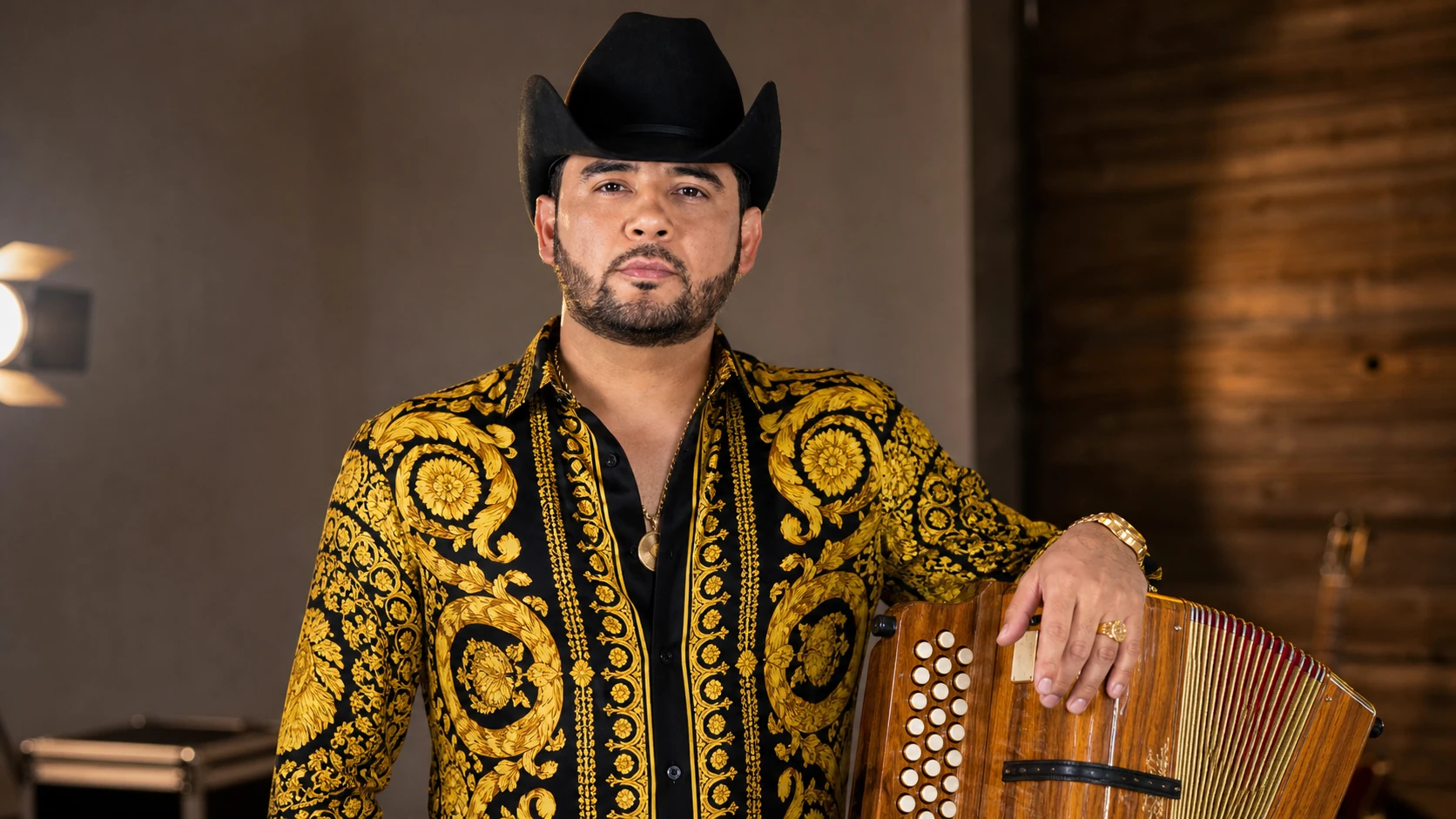
José Darey Castro is a Música Mexicana singer, accordionist, and songwriter best known as the central figure behind Dareyes de la Sierra, the regional Mexican act that has connected traditional sounds with the newer corridos tumbados movement. Based in Los Angeles and associated with Navojoa, Sonora, Castro built his career over more than two decades before reaching a wider international audience through his 2025 album Redención and the 2026 follow-up SABIA.
Although many listeners discovered him through collaborations with younger Música Mexicana stars, Castro’s career did not begin with that wave. He had already established a catalog through Dareyes de la Sierra, earned industry recognition as a songwriter and performer, and developed a reputation within regional Mexican music long before his recent resurgence.
The artist behind the Dareyes de la Sierra name
Darey Castro is the musician most closely identified with Dareyes de la Sierra, a name that has historically referred to a group but has increasingly become associated with Castro’s own artistic identity. The Los Angeles Times identified José Darey Castro as the singer and accordionist performing under the Dareyes de la Sierra name, while current Apple Music material presents the project as largely centered on Castro.

A trademark record for LOS DAREYES DE LA SIERRA lists the owner as José Darey Castro Borbón. That record supports the name used in business registration, although it does not serve as a public birth record.
The group’s roots are tied to Navojoa, Sonora, Mexico. While that location is consistently associated with Dareyes de la Sierra, publicly available sources do not independently confirm Castro’s exact birthplace.
Navojoa roots and a career built over decades
Castro’s musical path developed from an early connection with instruments. In an interview with the Los Angeles Times, he recalled receiving his first guitar from his father at age 10 and returning seriously to music during his teenage years.
His career grew through the regional Mexican scene surrounding Dareyes de la Sierra, a project whose history includes different stages and naming transitions. Some local accounts trace earlier roots of the group to the late 1990s, while Apple Music lists the act’s formation as 2004 and trademark records show the current name’s first-use claim in 2005. Because those records describe different milestones, the safest account is that Castro’s career stretches back more than two decades and developed through an evolving Navojoa-based musical project.
Before his recent international attention, Dareyes de la Sierra had already built a catalog recognized by regional Mexican audiences. Songs such as “Sufre,” “Enséñame A Olvidar,” and “Hasta El Día De Hoy” became important parts of the group’s history.
Songs, songwriting, and early recognition
Castro’s work has not been limited to performing. He is also credited as a songwriter, including on “Enséñame A Olvidar,” a song recognized by BMI at its 2013 Latin Music Awards. The organization’s records list Darey Castro alongside Edgar Cortázar and Adrián Pieragostino among the songwriters connected to the track.
Dareyes de la Sierra also received major industry recognition before its 2025 revival. The group was nominated for a Latin Grammy in 2009 for Una Copa Mas in the Best Banda Album category, according to BMI’s coverage of the nominations.
Another important early song was “Hasta El Día De Hoy,” which the Los Angeles Times reported remained on Billboard’s Regional Mexican Airplay chart for 11 weeks. The track helped establish the group’s presence within regional Mexican music before the rise of the newer corridos tumbados era.
A difficult turning point and continued musical growth
One of the major events in Castro’s public story came in 2004, when he survived a deadly attack. The Los Angeles Times reported the incident as part of his career history, describing it as a significant moment during his journey as an artist.
Details beyond the fact that he survived the attack remain less securely documented in accessible authoritative sources. As a result, the event is best understood as a serious turning point in his biography rather than a story defined by unverified details.
Despite that period, Castro continued developing his music. Dareyes de la Sierra explored different themes and styles, including the 2007 project “Los En-Kush-ados,” an early example of what the Los Angeles Times described as marijuana-themed “corridos verdes.”
Redención introduced Darey Castro to a new generation
Castro’s biggest modern career shift came with Redención, released in May 2025. The album arrived after a seven-year gap between major releases and represented a new chapter for Dareyes de la Sierra.
The project connected Castro with a younger generation of Música Mexicana artists, including Peso Pluma, Tito Double P, Neton Vega, and Gabito Ballesteros. The album’s combination of traditional regional Mexican influences and newer corridos tumbados sounds helped introduce his music to listeners who may not have followed his earlier work.
According to the Los Angeles Times, Redención debuted at No. 3 on Spotify’s Top Albums Debut Global chart. The album’s success also led to Castro’s first U.S. tour, a 20-date run scheduled for 2025.
The collaboration “Vita Fer,” featuring Tito Double P, became one of the standout songs from this period and reached No. 1 on Billboard’s Mexico Songs chart, according to the Los Angeles Times.
A deluxe edition of Redención followed in June 2025 through Double P Records, expanding the project to 28 tracks and reinforcing Castro’s connection with the contemporary Música Mexicana movement.
SABIA and Darey Castro’s current chapter
Castro continued that momentum with SABIA, released on April 16, 2026, through Double P Records. The album contains 21 tracks and reflects his continued movement between traditional regional Mexican sounds and newer musical approaches.
Apple Music describes SABIA as a continuation of Castro’s corridos tumbados direction while also incorporating a four-song reggaetón sequence with DJ Dímelo Ninow. Compared with the heavily collaborative approach of Redención, the album places greater emphasis on Castro’s own artistic identity.
The release represents another step in a career that has moved through multiple eras: the early regional Mexican work of Dareyes de la Sierra, the established songwriting and touring years, and the renewed attention brought by collaborations with a younger generation of artists.
Final thoughts
Darey Castro’s public story is not simply that of an older regional Mexican artist experiencing a late breakthrough. His recent success is built on a much longer foundation of songwriting, performance, and catalog development through Dareyes de la Sierra.
With Redención and SABIA, Castro has connected his earlier career with the current Música Mexicana landscape, showing how an artist with decades of experience can adapt to a changing audience while maintaining the identity that defined his work from the beginning.
