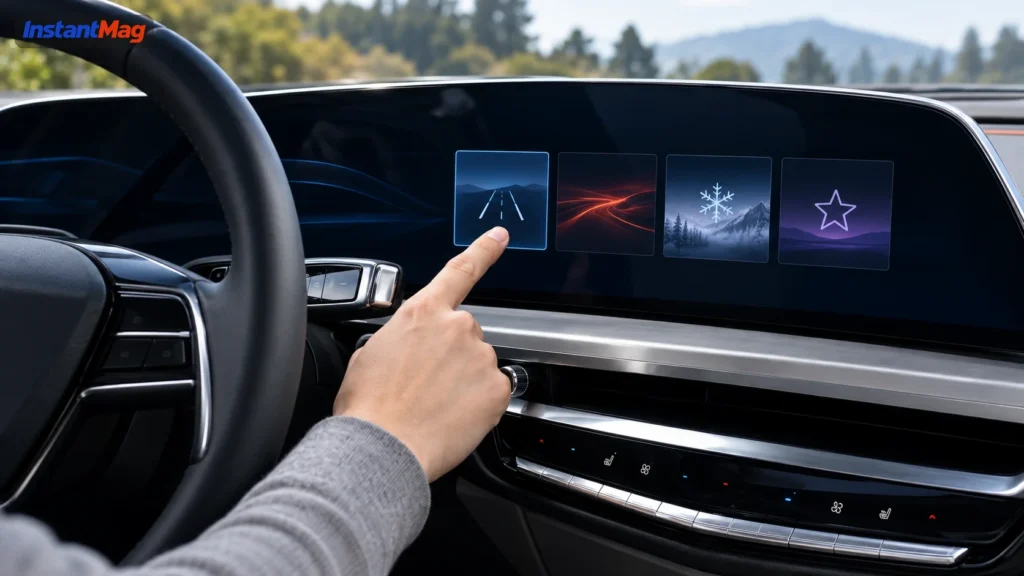

Cadillac does not publish a separate EPA range for Tour, Sport, Snow/Ice, or My Mode in the LYRIQ, and switching between those modes does not change the battery’s physical capacity. What can change is how the vehicle responds to the driver, how much energy it uses in real-world driving, and the remaining-range estimate shown on the dashboard.
That distinction matters because a falling range estimate does not necessarily mean a particular mode has consumed that many miles of battery. Cadillac’s LYRIQ documentation says the estimate responds to recent driving habits, operating conditions, HVAC use, and performance-oriented driving. There is also no verified universal figure showing that Sport Mode cuts range by 10%, 16–19%, 50 miles, or any other fixed amount.
As of September 20, 2026, Cadillac lists a 102 kWh battery capacity for the current U.S.-market LYRIQ, with EPA-estimated range varying by drivetrain and equipment—not by the standard driving mode selected.
The short answer: range rating and battery usage are not the same thing
The easiest way to understand LYRIQ drive modes is to separate four different measurements:
- Battery capacity is the amount of energy the battery is specified to hold.
- EPA-estimated range is a standardized range figure assigned to a vehicle configuration.
- Actual energy use is how much electricity the vehicle consumes during a particular trip.
- Displayed remaining range is a changing prediction based on how the vehicle has recently been driven and operated.
For the current 2027 LYRIQ, Cadillac’s specifications list a 102 kWh battery capacity and EPA-estimated ranges of 326 miles for rear-wheel drive, 319 miles for Dual Motor AWD with the standard 11.5-kW charging configuration, 303 miles for AWD with the available 19.2-kW charging configuration, and 285 miles for the LYRIQ-V.
Those differences belong to different vehicle configurations. Cadillac does not publish another set of figures saying, for example, that the same LYRIQ gets one EPA range in Tour and another in Sport.
What Tour, Sport, Snow/Ice, and My Mode actually change
The detailed descriptions in the 2025 Cadillac LYRIQ owner’s manual show that the standard modes are primarily vehicle-response settings.
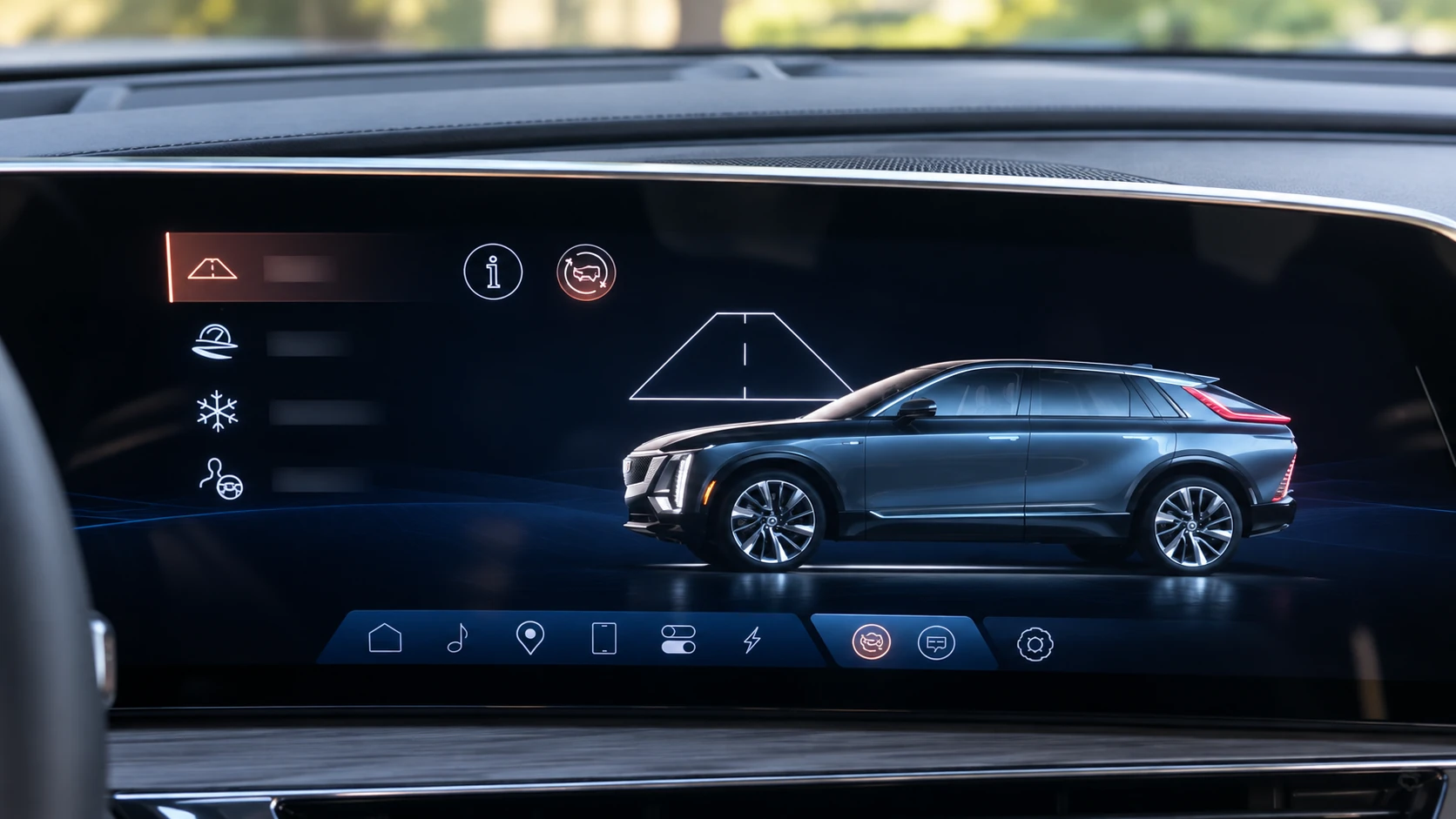
| Drive mode | What Cadillac documents | What that means for range |
|---|---|---|
| Tour | Normal city/highway setting balancing comfort and handling | A sensible everyday baseline, but not a guaranteed mileage figure |
| Sport | Changes pedal tuning, steering effort and other response settings; suspension and related systems may also change depending on equipment | Can lead to higher consumption if the sharper response is used for stronger acceleration, but there is no verified fixed penalty |
| Snow/Ice | Changes pedal response for traction and can alter eAWD and steering behavior | Intended for slippery conditions; no official fixed range loss is published |
| My Mode | Can customize acceleration feel, brake feel, steering, suspension and motor sound where equipped | Energy use depends on the selected settings and how the vehicle is driven |
Availability and exact behavior can differ by model year, trim, drivetrain and equipment, so owners should check the manual for their specific LYRIQ.
Does Sport Mode use more battery?
It can, but “Sport Mode uses X% more battery” is too simplistic.
Sport changes the LYRIQ’s response to accelerator input and makes the vehicle feel more immediate. If that sharper response leads to repeated hard acceleration, battery consumption can increase. The important mechanism is the energy demanded by the way the vehicle is being driven, rather than Sport somehow reducing the battery’s capacity.
That also means two drivers could use Sport Mode and see different results. One might repeatedly use strong acceleration; another might drive smoothly at a steady speed. Their energy use would not necessarily be the same simply because both selected Sport.
Cadillac’s manual supports the broader point by identifying aggressive acceleration, speed, operating conditions, HVAC use and performance modes among factors that can influence efficiency or the vehicle’s range estimate. It does not provide a universal Sport-versus-Tour percentage.
Claims circulating online that Sport Mode automatically costs 10–20% of range, 16–19%, or 50-plus miles should therefore not be treated as established LYRIQ specifications. No controlled authoritative test was identified that isolates the modes while keeping speed, route, temperature, state of charge, HVAC use and driver input constant.
Why the displayed range can change after different driving
The LYRIQ’s estimated remaining range is not a simple battery-percentage-to-miles conversion.
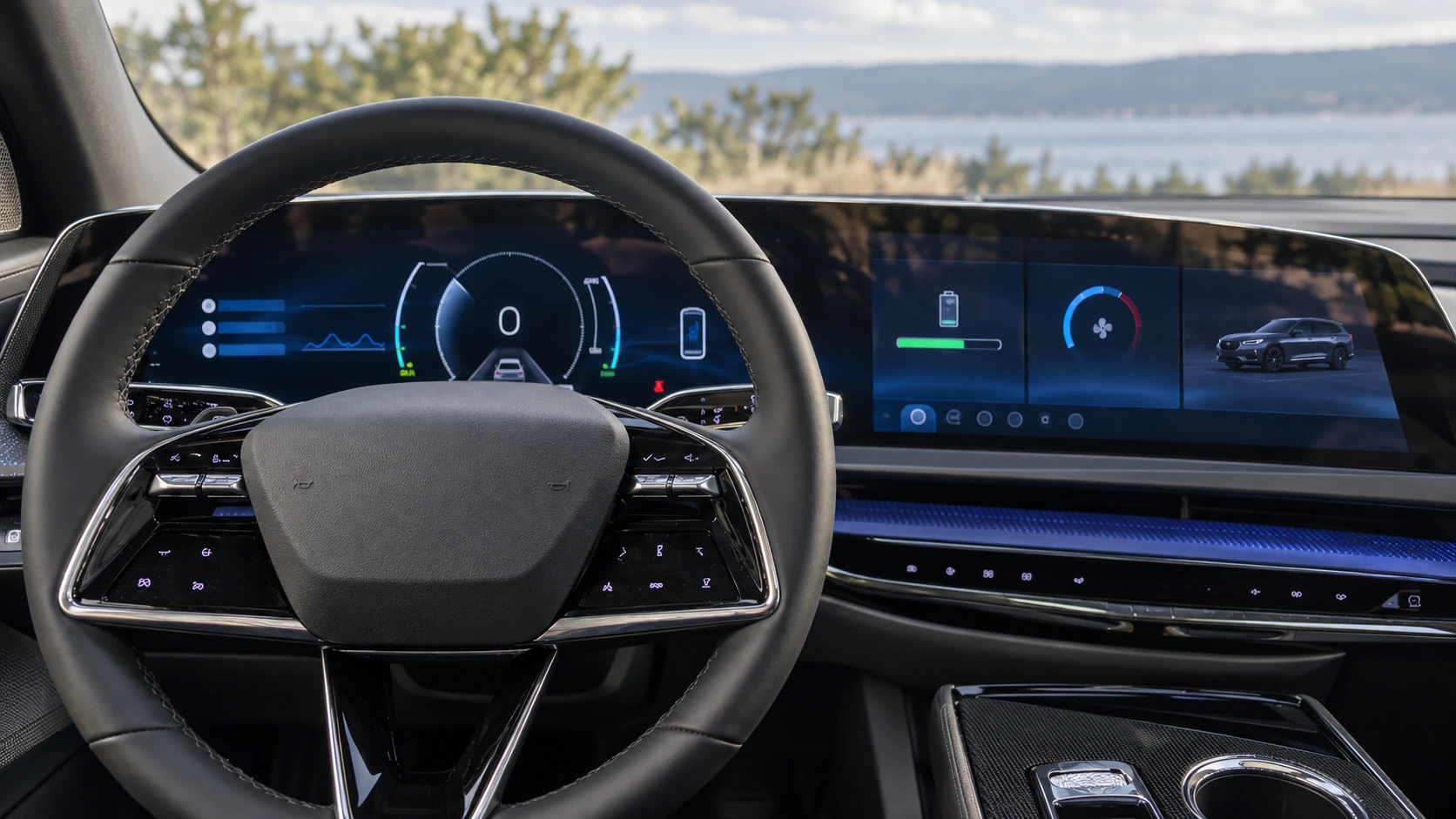
Cadillac’s manual says the estimate takes recent driving habits, operating conditions and HVAC usage into account. That means the number can move as the vehicle learns from recent consumption.
A period of harder acceleration, sustained highway speed, climbing grades or heavy climate-control use can push the estimate downward. More efficient recent driving can push it in the other direction.
This is why a driver should not assume that a 20-mile drop in the displayed estimate means a drive-mode button “used” 20 miles of range. The display is forecasting how far the remaining energy may take the vehicle under the conditions it is seeing.
EPA range works differently. The EPA’s EV range-testing guidance explains that official range estimates come from standardized laboratory driving cycles and are adjusted to better represent real-world factors such as high-speed driving, aggressive driving, air-conditioning use and cold temperatures.
An EPA estimate is therefore a standardized comparison number. The dashboard figure is a live prediction.
Does Snow/Ice Mode reduce LYRIQ range?
Cadillac does not publish a fixed Snow/Ice Mode range penalty.
The 2025 manual describes Snow/Ice Mode as a traction-oriented setting. It changes pedal response and, where applicable, eAWD and steering behavior to help the vehicle operate on slippery surfaces.
The larger problem when judging Snow/Ice efficiency is that the mode is usually selected under conditions that already affect EV consumption. Cold temperatures, cabin heating, battery conditioning, snow-covered pavement and greater rolling resistance can all influence how much energy the vehicle needs.
If a LYRIQ gets fewer miles from a charge during a winter trip, the loss cannot automatically be assigned to Snow/Ice Mode itself.
My Mode does not have one predictable range
My Mode makes a fixed range figure even less meaningful because it can combine different settings.
Cadillac’s documented options include acceleration feel, brake feel, steering, suspension and motor sound where equipped. A driver could therefore create a configuration with relaxed accelerator response or one that feels considerably sportier.
The result depends on those selections and, more importantly, on how the vehicle is then driven. Cadillac does not publish an EPA range for “My Mode” because there is no single My Mode configuration to measure against a universal number.
One point is worth keeping separate: “Brake Feel” should not automatically be interpreted as a regenerative-braking-strength control. Cadillac documents One-Pedal Driving and Regen on Demand as separate functions.
Regenerative braking is a separate part of the efficiency picture
Regenerative braking allows the electric motors to recover some energy while the vehicle slows and send that energy back toward the battery.
The LYRIQ provides One-Pedal Driving and Regen on Demand, but the inspected documentation does not establish that ordinary Tour, Sport and Snow/Ice modes each carry a predetermined different regenerative-braking level.
That distinction matters because some explanations of LYRIQ drive modes attribute Sport’s supposed range penalty to “reduced regen.” The official mode descriptions reviewed for this article do not support that as a general rule.
Regeneration can improve overall energy recovery, particularly in driving with repeated slowing, but it does not create free energy or guarantee a fixed number of extra miles.
The LYRIQ-V’s Velocity Max is the important exception
The LYRIQ-V adds a performance feature that Cadillac treats differently from the standard modes.
In its Velocity Max guidance, Cadillac explicitly warns that using Velocity Max depletes the battery faster than normal drive modes. It is designed to make the vehicle’s maximum available performance accessible, so higher energy demand is expected.
That is stronger evidence than exists for a universal penalty attached to ordinary Sport Mode.
It is also important not to reverse the logic. Because Cadillac explicitly says Velocity Max uses battery faster, that does not prove that standard Sport Mode carries a particular percentage penalty.
How to tell whether a drive mode is affecting your own LYRIQ
For owners trying to compare modes, actual energy-consumption information is more useful than watching the estimated-mile figure alone.
The LYRIQ’s Vehicle Status and Energy information can show trip energy use and recent efficiency. A meaningful personal comparison would involve repeating a similar route under similar conditions and looking at energy consumption rather than relying only on the predicted miles remaining.
Even then, several variables should be kept as consistent as possible:
- Starting battery state of charge
- Ambient temperature
- Cabin climate settings
- Route and elevation
- Traffic
- Average speed
- Tire pressure and wheel/tire setup
- Acceleration behavior
Without controlling those variables, a Tour-versus-Sport comparison can easily become a comparison of two different driving conditions rather than two modes.
Which LYRIQ mode should you use if range matters?
For ordinary driving, Tour is the logical baseline. Cadillac’s broader Driver Mode Control guidance describes Tour/Normal as its economical everyday setting, and the LYRIQ manual positions Tour as the normal city/highway mode.
That does not mean selecting Tour guarantees the maximum possible range. A LYRIQ driven rapidly at sustained highway speeds with heavy HVAC use can still consume substantial energy in Tour.
If range conservation is the priority, the stronger evidence points to practical behavior rather than chasing an unsupported mode-specific mileage number: accelerate smoothly, avoid unnecessary high speeds, account for weather and elevation, manage climate use sensibly, and make appropriate use of regenerative-driving features.
Sport is best understood as a responsiveness setting, Snow/Ice as a traction setting, and My Mode as a customization tool—not as three alternative battery sizes.
FAQ
Does Sport Mode lower the Cadillac LYRIQ’s EPA range?
Cadillac does not publish a separate EPA rating for Sport Mode. The official range figure belongs to the vehicle configuration. Sport can affect real-world consumption when its sharper response leads to stronger acceleration, but there is no verified universal percentage loss.
Can switching modes damage or reduce the battery’s capacity?
Switching among the standard drive modes does not change the LYRIQ’s specified battery capacity. A changing dashboard range estimate should not be confused with a change in physical battery capacity or battery health.
Why did my LYRIQ range estimate fall after using Sport Mode?
The range estimate responds to recent energy use and driving conditions. More aggressive acceleration or other high-consumption driving can cause the vehicle to project fewer remaining miles. Cadillac also identifies performance modes as one factor that can affect the estimate.
Is Snow/Ice Mode less efficient than Tour?
Cadillac does not publish a fixed Snow/Ice efficiency penalty. Because the mode is generally used in cold or slippery conditions, weather, cabin heating and road conditions can make it difficult to isolate the mode’s effect.
Does One-Pedal Driving change with Sport Mode?
The inspected Cadillac documentation treats One-Pedal Driving and Regen on Demand as separate functions rather than listing regenerative-braking strength as a standard Sport Mode parameter.
Conclusion
The Cadillac LYRIQ’s driving modes can influence how energy is used, but they do not give the vehicle different-sized batteries or separate published EPA ranges. Tour, Sport, Snow/Ice and My Mode mainly change the way the vehicle responds, while actual range depends on the combination of driver input, speed, weather, terrain, HVAC use and other operating conditions.
The most useful number to watch when comparing modes is therefore actual energy consumption over comparable trips—not an unsupported claim that Sport automatically costs a fixed percentage of range. The clear exception is LYRIQ-V’s Velocity Max, for which Cadillac specifically warns that battery depletion is faster.